
Workplace allegations involving bullying, harassment, misconduct or interpersonal conflict can quickly become complex.
Employers are often required to act promptly while also ensuring the process remains fair, impartial and evidence-based.
That balance matters.
An investigation is not simply about reaching an outcome. It is about establishing what occurred, considering the available evidence and ensuring the people involved have been given a fair opportunity to participate in the process.
For some matters, an internal investigation may be entirely appropriate. For others, the complexity of the allegations, seniority of the parties, potential conflicts of interest or perceived lack of independence may make an external investigator a more appropriate option.
At MAKAL, our approach is straightforward:
Independent. Objective. Workplace Facts.
The focus is on establishing a clear factual foundation so organisations can make their own informed and defensible decisions.
Why Independent Workplace Investigations Matter
A workplace investigation is a structured fact-finding process used to examine allegations, incidents or workplace concerns.
Depending on the matter, this may include allegations of:
- bullying
- harassment
- sexual harassment
- inappropriate workplace behaviour
- misconduct
- breaches of policy or procedure
- interpersonal conflict
- work-related stress events
- other workplace incidents requiring factual clarification
The purpose of an independent investigation is not to advocate for either party.
It is to gather relevant information, test the evidence, identify consistencies and inconsistencies, and reach findings based on the information available.
Independence can become particularly valuable where an organisation needs distance from the matter or where an internal investigator may reasonably be perceived as having a conflict of interest.
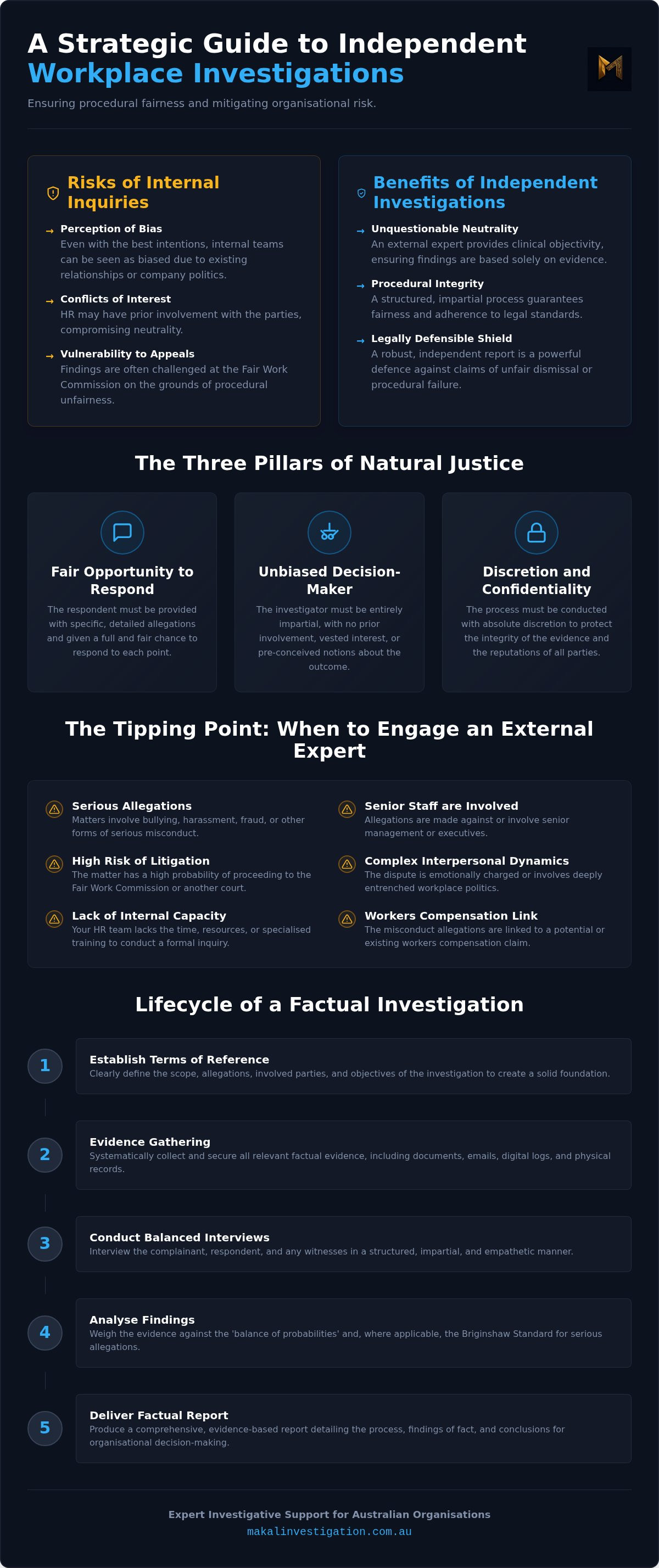
Procedural Fairness Is Central to the Process
A fair investigation requires more than simply interviewing people and preparing a report.
Procedural fairness should be built into the investigation from the beginning.
This generally includes ensuring that:
- allegations are clearly identified
- the respondent understands the substance of the allegations being considered
- the respondent is provided with a reasonable opportunity to respond
- relevant evidence is considered
- the investigator approaches the matter impartially
- findings are based on evidence rather than assumptions
- confidentiality and privacy are managed appropriately
- the investigation remains within its agreed scope
The objective is not to guarantee a particular result.
The objective is to ensure the pathway to the result is fair, logical and capable of being explained.
Internal Investigation or Independent Investigator?
Not every workplace matter requires an external investigator.
Internal HR, People and Culture, Employee Relations or management teams may be well placed to investigate lower-level matters, particularly where the issues are straightforward and there is no conflict of interest.
There are, however, circumstances where organisations may benefit from independent support.
These may include matters involving:
- senior managers or executives
- multiple witnesses
- competing versions of events
- allegations of serious misconduct
- bullying or harassment complaints
- sensitive interpersonal dynamics
- a potential conflict of interest
- previous unsuccessful attempts to resolve the issue
- significant documentary evidence
- a related psychological injury or workers compensation claim
- concerns about the perceived independence of an internal process
Engaging an independent investigator does not mean the internal team is incapable of conducting the investigation.
Sometimes independence itself is part of protecting the integrity of the process.
Establishing Clear Terms of Reference
A well-managed investigation begins with a clearly defined scope.
Terms of Reference should identify what the investigator has been asked to examine and what falls outside that scope.
This is important because workplace matters can easily expand.
During interviews, additional grievances, historical concerns or unrelated workplace issues may be raised.
Those matters may be important, but they do not automatically form part of the investigation.
Clear Terms of Reference help keep the investigation focused and ensure everyone understands what is being examined.
Gathering the Evidence
Workplace investigations rarely turn on one piece of information.
The investigator may need to consider a combination of:
- complainant evidence
- respondent evidence
- witness accounts
- emails
- text messages
- Teams or other workplace communications
- policies and procedures
- personnel records
- contemporaneous notes
- rosters
- incident reports
- CCTV footage
- electronic records
- other documentary evidence relevant to the allegations
An investigator should look at the evidence as a whole.
Where accounts differ, the task is not simply to choose which person appears more believable.
The investigator should consider whether statements are consistent with contemporaneous records, whether evidence can be independently corroborated, whether accounts remain consistent over time and whether other evidence supports or contradicts what has been said.
Conducting Fair and Balanced Interviews
Interviews are an important part of the investigation process.
A good investigation interview should provide the person with a genuine opportunity to explain their account.
That means asking clear questions, listening carefully, seeking clarification where needed and testing relevant inconsistencies without approaching the interview with a predetermined conclusion.
The investigator should remain objective while recognising that workplace investigations can be stressful for complainants, respondents and witnesses.
Professionalism and empathy can coexist with rigorous fact-finding.
From Evidence to Findings
Once the evidence has been gathered, the investigator must assess it logically.
The final report should show a clear pathway between:
Allegation → Evidence → Analysis → Finding
That pathway matters.
A report should allow the organisation to understand not only what finding was reached, but how the evidence led to that finding.
Where allegations are disputed, the investigator considers the evidence available and determines whether the allegation is substantiated, not substantiated or whether another appropriate finding is available under the agreed investigation framework.
The investigator's role is generally to establish the facts.
Decisions about disciplinary action, employment consequences or broader organisational action remain with the employer unless the Terms of Reference specifically provide otherwise.
When Investigation Reports Leave Questions Unanswered
Sometimes MAKAL's involvement may begin after investigative work has already been undertaken.
A report may contain significant information but still leave unanswered questions.
There may be:
- missing chronology
- evidence that has not been reconciled
- inconsistencies between witness accounts
- documentary evidence that has not been adequately considered
- gaps between what was alleged and what was ultimately found
- issues arising from workers compensation records or contemporaneous medical information
- conclusions where the evidentiary pathway is unclear
Experience in complex workers compensation matters has reinforced how important it is to examine the whole body of available information rather than looking at individual pieces of evidence in isolation.
Where appropriate, MAKAL can assist in reviewing available material, identifying factual gaps and bringing together relevant information so the organisation has a clearer picture of what the evidence actually establishes.
The Connection Between Investigations and Workers Compensation
Workplace investigations and workers compensation do not always sit in separate boxes.
An allegation of bullying, harassment, conflict or management action may later form part of a psychological injury claim.
Likewise, information generated during a workplace investigation may become relevant to the management or determination of a workers compensation matter.
This makes the quality of the original workplace process important.
Employers should avoid viewing an investigation purely through the lens of whether a future workers compensation claim might succeed or fail.
The investigation should first be conducted fairly and objectively on its own merits.
However, understanding the broader workers compensation environment can help identify where evidence, communication and process may later become important.
That intersection is one of the areas where MAKAL brings a different perspective.
The MAKAL Perspective
MAKAL Independent Workplace Investigations & Workers Compensation Advisory is founded by Millie Ioapo.
Millie brings approximately 20 years of end-to-end experience across the workers compensation field, with exposure spanning local government, state government, federal government, private-sector employers and self-insurance environments.
Her experience has been multi-jurisdictional, working across different Australian workers compensation schemes and organisational settings. This has included claim lodgement and determination, complex claims management, psychological and physical injury claims, return to work, injury management, medical evidence, stakeholder engagement, disputed matters and the review of complex claim information.
Working across different jurisdictions and employer environments has provided a broad understanding of how workers compensation matters can differ depending on legislation, organisational structure, insurer arrangements, internal processes and the circumstances of the individual claim.
Throughout complex claims work, Millie has also undertaken and supported lighter factual inquiries, examined competing accounts, reviewed investigation material and identified gaps where the available evidence did not fully support the conclusions being drawn.
This has often required going back to the source material: statements, correspondence, medical information, contemporaneous records, claim documentation and other available evidence and piecing together what the facts actually demonstrate.
That experience shapes MAKAL's approach.
It is not about making assumptions or forcing a matter into a predetermined outcome.
It is about asking the right questions, understanding the broader context, examining the available information and establishing a clear factual pathway.
MAKAL brings together workers compensation knowledge, practical claims experience and an investigative mindset to support organisations across complex workplace matters.
Fair Process. Clear Outcomes.
A workplace investigation should give an organisation greater clarity, not create more uncertainty.
A sound process should provide:
- clearly defined allegations
- a structured investigation pathway
- fair participation by the relevant parties
- careful consideration of evidence
- objective analysis
- findings that can be traced back to the evidence
Independence becomes particularly valuable when the matter is complex, sensitive or difficult for an organisation to investigate internally.
MAKAL provides independent workplace investigation and workers compensation advisory services with a focus on fairness, evidence and practical decision-making.
Workplace Facts. Fair Process. Clear Outcomes.
To discuss an independent workplace investigation or workers compensation advisory matter, contact MAKAL Independent Workplace Investigations & Workers Compensation Advisory.
Frequently Asked Questions
What is an independent workplace investigation?
An independent workplace investigation is a structured fact-finding process conducted by someone outside the immediate workplace or organisational decision-making structure.
The investigator gathers and assesses relevant evidence, interviews appropriate parties and prepares findings within an agreed scope.
The purpose is to provide an impartial factual basis from which the organisation can make its decisions.
When should an employer consider using an external investigator?
External investigation may be appropriate where the allegations are serious or complex, senior employees are involved, there is an actual or perceived conflict of interest, there are multiple witnesses or significant evidence to consider, or the organisation wants greater independence from the matter.
Does an independent investigator decide whether someone should be dismissed?
Generally, no.
The investigator's role is ordinarily to investigate allegations and make factual findings within the Terms of Reference.
Employment or disciplinary decisions remain the responsibility of the employer unless the investigator has specifically been engaged to perform another role.
What evidence can be considered during an investigation?
Relevant evidence can include interview accounts, witness information, emails, messages, policies, rosters, contemporaneous records, incident reports, CCTV footage and other documentation relating to the allegations.
What is relevant will depend on the individual matter.
Can workplace investigations affect workers compensation matters?
They can.
This is particularly relevant where a psychological injury claim involves allegations about workplace conduct, interpersonal conflict, disciplinary processes or management action.
Information from the investigation may later form part of a broader body of evidence considered in relation to the workers compensation matter.
Each workers compensation claim, however, must be considered under the legislation and circumstances applying to that particular claim.
What makes an investigation defensible?
There is no single document or process that guarantees an investigation will never be challenged.
A stronger investigation is one where the scope is clear, parties are treated fairly, relevant evidence is properly considered, the investigator remains impartial and the reasoning between the evidence and findings can be clearly followed.
How long does a workplace investigation take?
Timeframes depend on the complexity of the allegations, number and availability of witnesses, volume of evidence and whether additional issues arise during the investigation.
The priority should be to progress the matter without unnecessary delay while still allowing enough time for a fair and thorough investigation.